
Mermaids: Myth or Reality?
For centuries, sailors have told stories about mysterious beings with the upper body of a human and the tail of a fish. These creatures are known around the world as mermaids.
Some legends describe mermaids as beautiful and magical beings who live beneath the waves. Other stories portray them as dangerous creatures that lure sailors toward the sea. From ancient mythology to modern movies, mermaids have remained one of the world’s most famous mythical creatures.
But an interesting question remains:
Are mermaids real, or are they simply legends created by humans?
There is no scientifically verified evidence that human-like mermaids exist. However, the stories behind them are surprisingly old and appear in different cultures around the world.
To understand the mystery, we need to explore mythology, folklore, history, sailor stories, and science.
What Is a Mermaid?
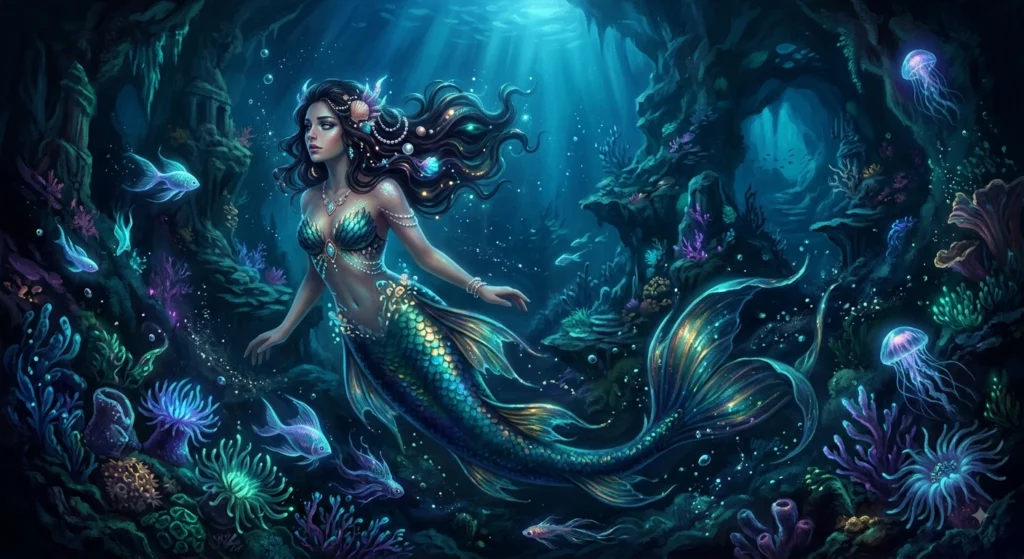
A mermaid is a legendary aquatic creature traditionally described as having the upper body of a human and the lower body of a fish.
The word “mermaid” combines two ideas:
- Mer – connected with the sea
- Maid – an old word associated with a young woman
The male version is commonly called a merman.
Mermaids are usually imagined as living in oceans, seas, rivers, or underwater kingdoms. Depending on the culture, they may be kind, mysterious, magical, dangerous, or even unlucky.
Popular stories often give mermaids supernatural abilities. They may control the sea, sing magical songs, predict disasters, or transform their appearance.
However, there is no single universal mermaid story.
Different civilizations developed their own versions of water spirits and human-like aquatic beings.
The Ancient Origins of Mermaid Legends
Mermaid mythology is much older than modern fairy tales.
One of the earliest stories often connected with mermaid-like mythology comes from ancient Mesopotamia.
Atargatis: An Ancient Water Goddess
The ancient Syrian goddess Atargatis is sometimes described as an early influence on later mermaid traditions.
According to later accounts, Atargatis was associated with water, fertility, and protection. She was connected with a story in which she entered a lake and became associated with a fish-like form.
Although Atargatis was not exactly the same creature as the modern mermaid, her mythology shows that the idea of a human-like being connected with water is extremely old.
This is important because it suggests that mermaid-like legends did not suddenly appear in modern European folklore.
They developed through thousands of years of storytelling.
Mermaids in Greek Mythology
Ancient Greek mythology also contains several beings connected with the sea.
One famous group is the Nereids, sea nymphs who were believed to live in the Mediterranean Sea.
They were daughters of the sea god Nereus and were often described as beautiful and helpful beings.
However, Nereids were not traditional mermaids. They were usually portrayed as human-like sea spirits rather than women with fish tails
.
Sirens and Mermaids: Are They the Same?
People often confuse sirens with mermaids.
They are actually different mythological beings.
In early Greek mythology, sirens were dangerous creatures associated with the sea. They were famous for their enchanting voices, which could attract sailors toward destruction.
Later European art and popular culture sometimes represented sirens as fish-tailed women.
This helped create confusion between the traditional siren and the modern image of the mermaid.
The famous idea of a beautiful sea woman singing to sailors is therefore influenced by several different traditions
.
Mermaids in European Folklore
Mermaid stories became especially popular throughout medieval and early modern Europe.
Different regions developed their own versions.
In some stories, mermaids were beautiful and mysterious.
In others, they were dangerous creatures connected with storms, shipwrecks, drowning, or bad luck.
The Mermaid as a Warning
For sailors, the ocean was unpredictable and dangerous.
Before modern navigation, weather forecasting, and communication systems, people had limited knowledge about what was happening far from land.
A mysterious story about a supernatural woman living in the sea could help explain strange events.
If a ship disappeared, a mermaid could become part of the explanation.
If a sailor claimed to see a mysterious figure in the water, the story could become more dramatic each time it was retold.
Over generations, these stories became part of local folklore.
Mermaids in Irish and Scottish Folklore
Mermaid-like beings also appear in the folklore of Ireland and Scotland.
One famous example is the merrow, a supernatural sea being from Irish folklore.
Merrows were associated with the sea and were sometimes described as having magical clothing or abilities that allowed them to travel through water.
Scottish folklore also contains stories of selkies.
Selkies are not mermaids. They are magical seal-like beings that can take human form.
These legends show how different cultures connected the mysterious ocean with creatures that could move between the human world and the underwater world.
Mermaids in Asian Folklore
Mermaid-like creatures are not limited to Europe.
Many Asian cultures have stories about supernatural beings associated with water.
Ningyo in Japanese Folklore
Japanese folklore includes the ningyo, a mysterious aquatic creature.
The ningyo is sometimes translated as “mermaid,” although traditional descriptions can be very different from the modern Western image of a beautiful woman with a fish tail.
Some stories describe ningyo as strange creatures with human-like features.
In certain legends, eating a ningyo could supposedly provide extraordinary longevity.
One famous Japanese tale tells of a woman who lived for an unusually long time after consuming the flesh of a mysterious aquatic creature.
Water Spirits Across Asia
Other Asian traditions contain stories of river spirits, serpent-like beings, fish spirits, and supernatural aquatic creatures.
These traditions demonstrate an important point:
Humans across different cultures have imagined mysterious beings living beneath or near water.
The stories may look different, but the fascination with the unknown is remarkably similar.
Mermaids in African and Caribbean Traditions
Water-spirit traditions also appear in African and Caribbean folklore.
One well-known example is Mami Wata, a powerful water spirit associated with various African and African-diaspora traditions.
Mami Wata is often represented as a beautiful woman associated with water, wealth, mystery, and supernatural power.
Her appearance can sometimes include a fish or serpent.
However, Mami Wata should not simply be called an African mermaid.
She belongs to a much broader and more complex spiritual tradition with many regional variations.
The comparison is useful because it shows how water spirits have developed independently across different cultures.
Why Did People Believe in Mermaids?
The ocean has always been mysterious.
For most of human history, people could not explore the deep sea.
They did not know what lived beneath the surface.
Today, scientists use submarines, underwater cameras, sonar, and remotely operated vehicles to explore the ocean.
Ancient sailors had none of these technologies.
Imagine sailing for weeks across a huge ocean and seeing an unfamiliar animal near your ship.
Without modern biology, you might interpret it through the stories you already knew.
This could easily transform an unusual animal into a supernatural creature.
Could Manatees Have Inspired Mermaid Stories?
One of the most popular scientific explanations for mermaid sightings involves manatees and dugongs.
These large aquatic mammals have rounded bodies, flippers, and tails.
From a distance, especially after a long journey at sea, a sailor might mistake one for something unusual.
When animals appear briefly above water, humans do not always identify them correctly.
Poor visibility, distance, waves, exhaustion, and imagination can all affect perception.
Christopher Columbus and Mermaid Sightings
Historical accounts associated with Christopher Columbus mention seeing creatures he interpreted as mermaids during his voyages.
Modern interpretations often suggest that the animals may have been manatees.
The animals probably did not look exactly like the beautiful mermaids shown in modern movies.
But sailors were viewing them from a distance and under difficult conditions.
This is one possible explanation for some historical sightings.
Other Animals That May Have Inspired Mermaids
Manatees are not the only possible source of mermaid stories.
Several marine animals can look surprisingly unusual from a distance.
Possible sources of mistaken sightings include:
- Manatees
- Dugongs
- Seals
- Sea lions
- Large fish
- Dolphins
- Whales
- Floating debris
- People swimming in the distance
The human brain is also very good at finding familiar shapes in unclear images.
A distant object may appear human-like even when it is not.
This psychological effect is called pareidolia.
What Does Science Say About Real Mermaids?
From a scientific perspective, there is currently no reliable evidence that mermaids exist.
No verified mermaid body, skeleton, DNA sample, fossil, or living population has been discovered.
Marine biology has documented thousands of species, including many strange and fascinating animals.
But none have been scientifically confirmed as human-fish hybrids.
Why Would a Mermaid Be Difficult to Evolve?
A human-like upper body combined with a fish-like lower body would require an extremely unusual evolutionary pathway.
Humans are mammals.
Fish belong to a completely different branch of vertebrate evolution.
A creature with human anatomy above the waist and fish anatomy below it would raise major biological questions involving:
- Respiration
- Reproduction
- Skeleton structure
- Temperature regulation
- Movement
- Digestion
- Circulation
- Development
Evolution does produce extraordinary animals, but there is no evidence that it produced a creature matching the traditional mermaid design.
Could Mermaids Live in the Deep Ocean?
Some people argue that mermaids might live in unexplored parts of the ocean.
It is true that humans have explored only a fraction of the deep ocean in detail.
Scientists continue to discover new marine species.
However, an unknown species would not automatically be a mermaid.
A large population of intelligent, human-sized aquatic creatures would likely leave evidence through bodies, remains, DNA, feeding patterns, sounds, or interactions with marine ecosystems.
So far, there is no credible scientific evidence supporting the existence of mermaids.
Famous Mermaid Sightings
Mermaid sightings have appeared in stories, newspapers, books, and sailor accounts for hundreds of years.
Some reports were probably misunderstandings.
Others may have been deliberate hoaxes.
And some stories may have simply grown through repeated retelling.
The Fiji Mermaid
One of the most famous mermaid-related hoaxes was the Fiji Mermaid, associated with the American showman P. T. Barnum.
The creature was presented as a real mermaid attraction.
In reality, it was a constructed object made from animal parts.
The story became extremely popular because people were fascinated by the possibility that mermaids were real.
This demonstrates how easily curiosity can turn a fabricated object into a famous legend.
Mermaids in Popular Culture
Modern media transformed the mermaid from a frightening sea spirit into a much more diverse character.
One of the most influential examples is The Little Mermaid, based on the fairy tale by Hans Christian Andersen.
The story helped popularize the image of a young mermaid who wants to experience the human world.
Movies, cartoons, books, games, and television shows continued this transformation.
Today, mermaids can be:
- Heroes
- Villains
- Princesses
- Sea warriors
- Magical creatures
- Romantic characters
- Guardians of the ocean
- Symbols of freedom
The modern mermaid is therefore very different from many of the darker creatures found in traditional folklore.
Why Are Mermaids Still Popular?
Mermaids combine several things humans have always found fascinating.
1. The Mystery of the Ocean
The ocean represents the unknown.
Even today, deep-sea exploration continues to reveal strange creatures and environments.
2. Human Curiosity
People have always wondered what might exist beyond the known world.
Mermaids provide a perfect symbol for that curiosity.
3. Beauty and Danger
Traditional mermaid stories often combine attraction with danger.
A beautiful creature can also represent the unpredictable power of the sea.
4. Transformation
Mermaids exist between two worlds.
They are partly human and partly aquatic.
This makes them powerful symbols of identity, transformation, and mystery.
Mermaid Mythology vs. Reality
| Mermaid Myth | Reality |
| Mermaids are half-human and half-fish | No scientific evidence supports this |
| Mermaids live underwater kingdoms | Part of folklore and fantasy |
| Mermaids can control the sea | Mythological belief |
| Mermaids sing magical songs | Common folklore motif |
| Sailors regularly encounter mermaids | Historical reports are unverified |
| Manatees may have inspired sightings | Possible explanation for some reports |
| Mermaids exist in many cultures | Yes, water-being traditions are widespread |
The difference between mythology and reality is important.
A legend can be culturally meaningful without being scientifically true.
Why Do Mermaid Legends Survive?
Legends survive because people continue to tell them.
A story becomes stronger when it connects with something people already fear, love, or wonder about.
The ocean provides all three.
It can be beautiful.
It can provide food and transportation.
It can also be incredibly dangerous.
For ancient communities, the sea was not simply a geographical feature.
It was a mysterious world filled with unknown forces.
Mermaid stories gave that mystery a human face.
Are Mermaids Myth or Reality?
So, are mermaids myth or reality?
Based on current scientific evidence, mermaids belong to mythology and folklore rather than the natural world.
There is no verified evidence that human-fish creatures exist.
However, that does not make mermaid stories meaningless.
They are valuable pieces of cultural history.
They tell us how ancient people understood the ocean, how sailors explained unusual experiences, and how different cultures imagined supernatural worlds.
Some historical sightings may have been inspired by real animals such as manatees and dugongs.
Others may have been exaggerations, mistakes, hoaxes, or imaginative stories.
The creature itself may be mythical, but the human fascination behind the legend is very real.
Mermaids: The Legend Lives On
From ancient water spirits to modern fantasy movies, mermaids have traveled across centuries of human imagination.
Their stories have changed dramatically.
In some traditions, they are dangerous.
In others, they are beautiful and magical.
Some stories portray them as guardians of the sea, while others present them as mysterious creatures that lure humans into the water.
Science has not discovered evidence of real mermaids.
But the legend continues because the ocean still represents one of Earth’s greatest mysteries.
Perhaps that is the real magic of mermaids.
They may not live beneath the waves, but they continue to live in our stories.
Conclusion
Mermaids are one of the most enduring legends in world folklore.
They appear in different forms across cultures, from ancient water deities and sea spirits to the modern image of a beautiful woman with a fish tail.
Science currently provides no evidence that mermaids are real biological creatures. Some reported sightings may have been caused by animals such as manatees and dugongs, while others likely came from folklore, imagination, or hoaxes.
But perhaps the most interesting part of the mermaid mystery is not whether they exist.
It is why humans created and preserved these stories in the first place.
Mermaids represent our fascination with the unknown. They remind us that, even in an age of satellites, submarines, and advanced technology, the ocean still has the power to inspire mystery.
Frequently Asked Questions About Mermaids
Are mermaids real?
There is no scientifically verified evidence that mermaids exist. They are generally considered mythical creatures.
Where did mermaid stories originate?
Mermaid-like water beings appear in multiple ancient cultures. Some traditions are thousands of years old and developed independently.
Could mermaid sightings be manatees?
Some historical sightings may have involved manatees or dugongs. These animals can appear surprisingly human-like from a distance.
Are sirens and mermaids the same?
No. Sirens originated in Greek mythology and were traditionally different from mermaids. Later artwork and popular culture sometimes combined the two ideas.
Do mermaids appear in Indian folklore?
India has many traditions involving supernatural water beings, river spirits, serpent beings, and aquatic creatures. However, these traditions are not necessarily identical to the Western mermaid concept.
What is the most famous mermaid story?
Hans Christian Andersen’s The Little Mermaid is one of the world’s best-known mermaid stories and has inspired numerous adaptations.
Why did sailors report seeing mermaids?
Possible explanations include mistaken identification of marine animals, poor visibility, exhaustion, optical illusions, storytelling, and deliberate hoaxes.
Have scientists found a real mermaid?
No. Scientists have not discovered a verified mermaid body, skeleton, DNA sample, or living population.