
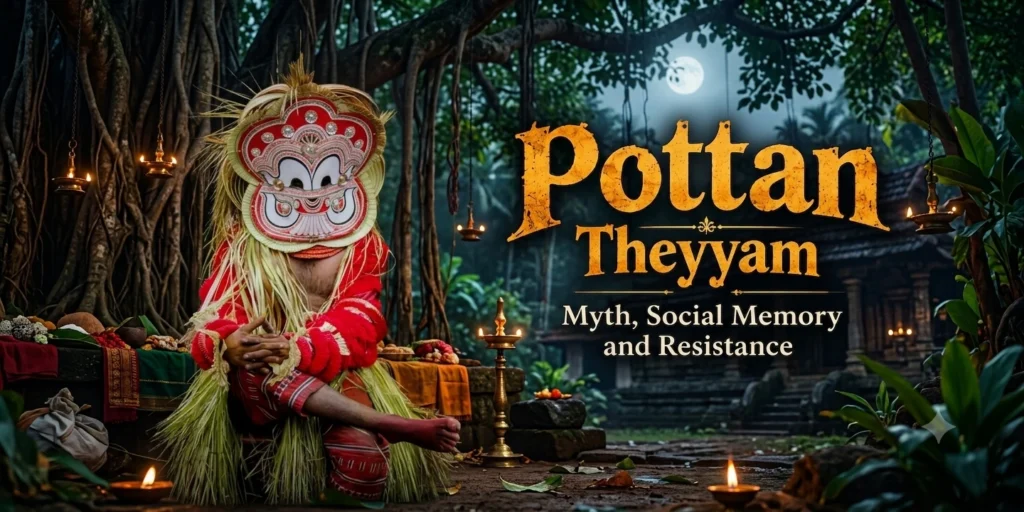
Among the many powerful ritual traditions of North Kerala, Pottan Theyyam stands out for its deep social and cultural message. It is not simply a colourful ritual performance with elaborate costumes, music, dance, and sacred transformation. Pottan Theyyam represents human dignity, equality, social memory, and resistance against caste discrimination.
For generations, the story of Pottan Theyyam has been remembered and performed through oral tradition. Its myth carries a strong message: no human being is superior or inferior because of caste or birth. Through ritual performance, the story becomes alive again, reminding society about injustice and the need to question discrimination.
Pottan Theyyam is therefore more than mythology. It is a living cultural memory of Kerala’s social struggles and a powerful symbol of resistance.
What Is Pottan Theyyam?
Pottan Theyyam is one of the important forms of Theyyam, the ritual performance tradition mainly found in the Malabar region of Kerala. In Theyyam rituals, the performer undergoes a transformation through costume, makeup, dance, music, and sacred rituals. During the performance, the performer is believed to represent or embody a divine presence.
What makes Pottan Theyyam unique is its strong social message. The character is closely associated with the idea of challenging caste hierarchy and questioning social inequality.
The ritual tradition uses performance as a powerful form of communication. Instead of a written book or political speech, Pottan Theyyam communicates its message through:
- Myth and oral storytelling
- Ritual performance
- Dialogue and songs
- Symbolic actions
- Public participation
- Sacred transformation
This makes Pottan Theyyam an important example of how folklore can preserve social ideas across generations.
The Myth Behind Pottan Theyyam
The story of Pottan Theyyam is commonly connected with the philosophical traditions surrounding Adi Shankaracharya and the question of caste discrimination.
According to popular versions of the oral tradition, Shankaracharya encounters a person from a socially oppressed community. The encounter challenges the idea that spiritual knowledge or human dignity can be divided according to caste.
The central question becomes powerful:
If the same life exists within every human being, how can one person claim to be superior to another?
This idea challenges the traditional social hierarchy. The figure associated with Pottan becomes a symbol of truth, questioning, and resistance.
The myth transforms an ordinary encounter into a larger philosophical message about:
- Human equality
- Spiritual unity
- Social justice
- Caste discrimination
- Human dignity
Through the ritual, these ideas continue to survive in cultural memory.
Pottan Theyyam and the Question of Caste
One of the strongest themes connected with Pottan Theyyam is the criticism of caste-based discrimination.
Traditional Indian society was historically structured through complex social hierarchies. Many communities faced exclusion and discrimination based on birth. Access to knowledge, temples, public spaces, and social opportunities was often unequal.
Pottan Theyyam challenges this hierarchy through folklore.
The character does not silently accept discrimination. Instead, the myth raises questions about the logic behind caste superiority. The performance symbolically asks society to look at itself and question its own values.
This is what makes Pottan Theyyam especially important.
The ritual does not only celebrate a divine story. It also preserves a social argument.
Myth as a Form of Resistance
Resistance does not always appear through protests, political movements, or written documents. Sometimes resistance survives through stories, songs, rituals, and performances.
Pottan Theyyam is an example of cultural resistance.
The story challenges systems of inequality by preserving an alternative message: every human being deserves dignity.
Through performance, the message reaches ordinary people. It becomes part of collective memory rather than remaining limited to scholars or religious texts.
Folklore has always played an important role in this process. Communities use stories to:
- Remember injustice
- Preserve identity
- Question authority
- Share moral values
- Challenge social discrimination
- Pass experiences to future generations
Pottan Theyyam demonstrates how ritual traditions can become powerful spaces for social expression.
Social Memory in Pottan Theyyam
Social memory refers to the way communities remember their past together. Not every historical memory is preserved in official records or written books. Many experiences survive through oral traditions.
Pottan Theyyam carries such memories.
The ritual performance keeps alive conversations about caste, inequality, dignity, and social relationships. Every performance becomes a moment of remembering.
This memory is important because societies often forget uncomfortable parts of their history. Folklore, however, can preserve what official narratives sometimes ignore.
Through Pottan Theyyam, the memory of social inequality is not completely erased.
Instead, it returns through:
1. Oral Tradition
Stories are passed from one generation to another.
2. Ritual Performance
The myth is physically performed before the community.
3. Sacred Space
The performance takes place within a cultural and ritual environment that gives the message deeper meaning.
4. Collective Participation
People gather, watch, listen, and interact with the ritual tradition.
Because of this, Pottan Theyyam becomes a form of living history.
The Power of the Performer
The transformation of the performer is one of the most fascinating aspects of Theyyam traditions.
Before the ritual, the performer is an ordinary individual within society. Through preparation, costume, makeup, music, and ritual practices, the performer transforms into the sacred figure of Pottan Theyyam.
This transformation creates an important cultural moment.
The performer represents a divine and symbolic authority before the audience. In this space, social questions can be expressed through ritual.
This creates a powerful reversal.
A person who may historically belong to a marginalized community can become the centre of spiritual attention during the performance. People from different social backgrounds come to witness, respect, and seek blessings from the divine figure.
This symbolic transformation gives Pottan Theyyam a strong social meaning.
Pottan Theyyam and the Idea of Equality
At the heart of the tradition is a simple but powerful idea:
Human worth cannot be measured by birth.
The philosophical message connected with Pottan Theyyam challenges the idea that caste determines spiritual purity or human value.
The tradition reminds people that:
- Every human life has dignity.
- Knowledge is not limited by birth.
- Spiritual truth cannot belong to only one group.
- Social discrimination must be questioned.
- Equality is a fundamental human value.
These ideas make Pottan Theyyam relevant even today.
Although society has changed in many ways, caste discrimination and social inequality continue to remain important issues. The message of Pottan Theyyam therefore continues to speak to modern audiences.
Folklore as a Voice for Marginalized Communities
Folklore is often created and preserved by ordinary communities. Unlike royal histories or official documents, folklore can represent voices that were excluded from formal records.
Pottan Theyyam shows how cultural traditions can preserve the experiences and perspectives of marginalized communities.
Stories and performances allow communities to express:
- Pain
- Injustice
- Identity
- Resistance
- Hope
- Social criticism
This is one of the reasons folklore is so important.
It is not simply entertainment.
Folklore can act as a cultural archive.
Pottan Theyyam preserves memories and ideas that continue to challenge social inequality.
The Symbolism of Pottan Theyyam
The symbolism of Pottan Theyyam works on multiple levels.
Mythological Symbolism
The story connects with spiritual and philosophical ideas about the unity of human existence.
Social Symbolism
The character challenges caste hierarchy and discrimination.
Cultural Symbolism
The ritual represents the rich oral traditions of North Kerala.
Political Symbolism
The story can be understood as a form of cultural resistance against systems of oppression.
Human Symbolism
At its core, Pottan Theyyam represents the universal idea of human dignity.
These layers make the tradition meaningful to different audiences.
Why Pottan Theyyam Still Matters Today
Pottan Theyyam is not only important because it belongs to Kerala’s cultural past. Its message remains relevant in the modern world.
Even today, societies continue to struggle with:
- Caste discrimination
- Social inequality
- Marginalization
- Identity conflicts
- Exclusion
- Lack of equal opportunities
The story of Pottan Theyyam reminds us that questions about equality are not new. Communities have been challenging injustice through stories and traditions for generations.
The ritual therefore connects the past with the present.
It asks modern society an important question:
Have we truly moved beyond the inequalities that our ancestors questioned?
Pottan Theyyam as a Living Cultural Archive
A book can preserve history through written words. A museum can preserve history through objects.
But Theyyam preserves memory through living performance.
Every ritual performance requires:
- A performer
- Traditional knowledge
- Costume and makeup
- Music and rhythm
- Oral narratives
- Community participation
- Sacred spaces
Without people, the tradition cannot survive.
This makes Pottan Theyyam a living archive.
The knowledge is carried through generations by communities, artists, ritual specialists, and local cultural traditions.
Protecting such traditions means protecting more than costumes and performances. It means protecting the stories, memories, and social ideas connected with them.
Myth, Memory and Resistance: The Three Layers of Pottan Theyyam
Pottan Theyyam can be understood through three important layers.
1. Myth
The myth provides the story and philosophical foundation of the ritual. It explores questions about human equality and spiritual truth.
2. Social Memory
The performance preserves collective memories about caste, discrimination, and social relationships.
3. Resistance
The tradition challenges systems of inequality by presenting a powerful message about dignity and equality.
Together, these three elements make Pottan Theyyam one of the most socially meaningful traditions within Kerala folklore.
The Role of Oral Tradition
Many details of folklore change over time because stories are passed orally from generation to generation.
This does not make oral tradition less valuable.
Instead, it shows that folklore is alive.
Different communities may remember and interpret Pottan Theyyam in different ways. The meaning of the ritual can also change depending on the social context.
Oral traditions allow communities to continuously engage with their past.
They are not frozen stories.
They grow, adapt, and continue to speak to new generations.
Pottan Theyyam and Kerala’s Cultural Identity
Kerala is known for its rich traditions of folklore, ritual art, mythology, and oral storytelling.
Theyyam occupies an important place within this cultural landscape.
Pottan Theyyam is especially significant because it connects artistic performance with social ideas.
It represents the combination of:
- Ritual
- Art
- Mythology
- Philosophy
- Folklore
- Social criticism
This combination makes the tradition culturally powerful.
For researchers, cultural enthusiasts, and future generations, Pottan Theyyam offers an opportunity to understand how art and society influence each other.
Protecting the Meaning Behind the Performance
Today, Theyyam has gained wider attention through tourism, photography, documentaries, and social media.
While greater visibility can help introduce Kerala’s cultural traditions to new audiences, it also creates an important responsibility.
Pottan Theyyam should not be viewed only as a colourful visual performance.
Its deeper meaning should also be remembered.
The tradition carries stories about:
- Human dignity
- Equality
- Social struggle
- Cultural memory
- Resistance
Understanding these messages helps audiences appreciate the ritual beyond its visual beauty.
Preserving folklore means protecting both the performance and its meaning.
Conclusion: A Ritual That Continues to Ask Questions
Pottan Theyyam is more than a mythological character or ritual performance. It is a living symbol of social memory and resistance.
Through its powerful story, the tradition questions caste hierarchy and reminds society about the importance of human dignity. Through ritual performance, the message survives across generations.
Pottan Theyyam shows us that folklore is not only about the past.
Folklore can question the present.
It can preserve forgotten voices.
It can challenge injustice.
And it can remind society of values that should never be forgotten.
The story of Pottan Theyyam continues to carry one powerful message:
No human being should be judged as superior or inferior because of birth.
That is why Pottan Theyyam remains one of the most meaningful examples of myth, social memory, and resistance in Kerala folklore.