
Few supernatural creatures have captured the human imagination like the vampire. Stories of mysterious beings that rise from the dead, drink blood, or drain the life of the living appear in many cultures. Although modern movies often portray vampires as elegant immortals with sharp fangs, traditional vampire legends are much more diverse.
Different societies created their own explanations for death, disease, unexplained disappearances, and strange nighttime experiences. Some vampire-like creatures were believed to return from graves, while others were spirits, demons, witches, or supernatural beings that attacked the living.
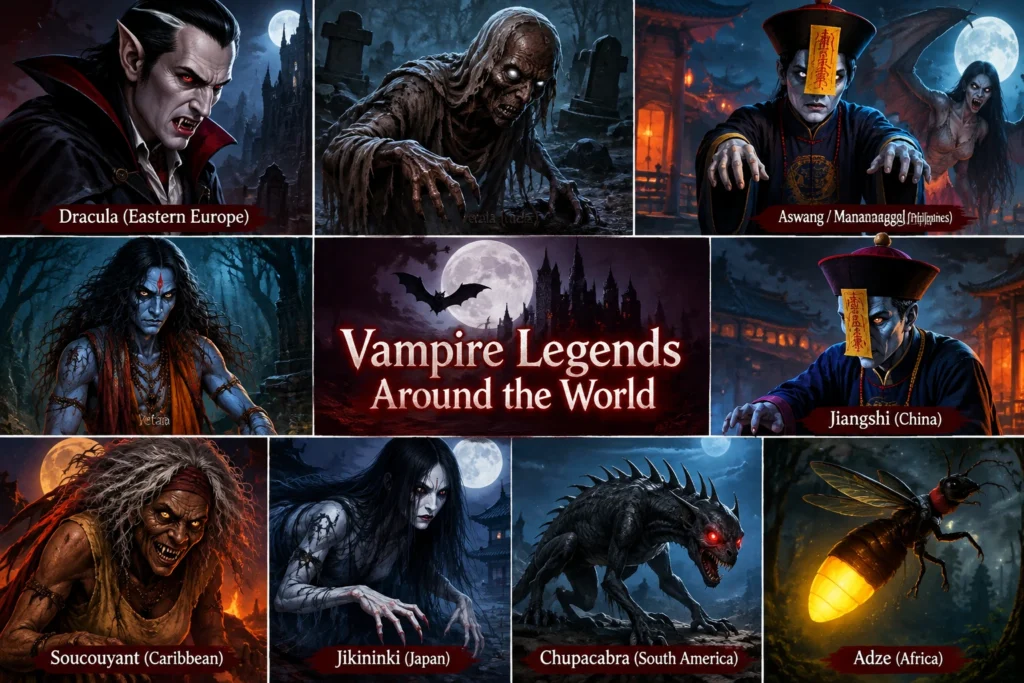
From the famous Dracula stories of Eastern Europe to the mysterious Jiangshi of China and Vetala traditions in India, vampire folklore reveals how different cultures understood death and the unknown.
What Is a Vampire?
A vampire is generally described in folklore as a supernatural being that feeds on the life force or blood of living people. The exact appearance and behavior of vampires vary greatly between cultures.
Some legends describe them as dead people who return from their graves. Others describe creatures that look completely human but possess supernatural powers.
Common vampire characteristics include:
- Feeding on blood or life energy
- Appearing at night
- Returning from the dead
- Possessing supernatural strength
- Causing illness or weakness
- Transforming into animals
- Living between the worlds of the living and the dead
However, not every vampire legend includes blood drinking. In some traditions, supernatural creatures were believed to consume life energy, breath, souls, or vital force instead.
Vampire Legends in Eastern Europe
Eastern Europe is strongly associated with vampire folklore. Countries such as Romania, Serbia, Bulgaria, and neighboring regions developed numerous stories about the restless dead.
In traditional beliefs, a person who died under unusual circumstances could sometimes return from the grave. The undead might visit family members at night and cause sickness or death.
These stories became particularly influential in the development of the modern vampire.
The Vampire of Serbia
Serbian folklore contains some of the earliest documented European vampire traditions. The Serbian word vampir is often connected with the modern English word “vampire.”
Stories described deceased people returning to their communities and attacking the living. In some accounts, unusual deaths and unexplained illnesses were blamed on these restless corpses.
Fear of vampires was sometimes connected to uncertainty about whether a person was truly dead. Before modern medicine, death could be difficult to confirm, creating fertile ground for supernatural explanations.
Dracula and Romanian Vampire Folklore
No vampire story is more famous than Dracula.
The fictional Count Dracula was created by Irish author Bram Stoker in his 1897 novel Dracula. The character became associated with Transylvania, a historical region of present-day Romania.
Dracula was influenced by earlier vampire traditions as well as historical figures and Gothic literature. One figure commonly associated with the Dracula legend is Vlad III, also known as Vlad the Impaler.
However, Vlad was not literally a vampire. The connection between Vlad and Dracula was strengthened through later literature, tourism, films, and popular culture.
Modern Dracula became the image of the sophisticated vampire: pale, mysterious, powerful, immortal, and associated with blood.
Vampire-Like Legends in India
India has a rich tradition of supernatural folklore involving spirits, ghosts, demons, and beings associated with the dead.
One famous example is the Vetala. Found in Hindu and South Asian storytelling traditions, a Vetala is a supernatural being associated with corpses and burial grounds.
The Vetala is particularly famous through the Vikram and Vetala stories. In these tales, King Vikramaditya encounters a supernatural being that occupies a corpse and challenges him with difficult riddles and moral questions.
Unlike the modern Western vampire, the Vetala is not simply a blood-drinking creature. Its connection with corpses, spirits, death, and supernatural knowledge makes it an important part of South Asian supernatural folklore.
The Rakshasa and Other Indian Traditions
Indian mythology also contains various supernatural beings that have sometimes been compared with vampires in modern interpretations.
Rakshasas, for example, are powerful supernatural beings appearing in Hindu traditions and literature. Some are portrayed as dangerous creatures that attack or consume humans.
However, it is important not to label every Indian supernatural creature a “vampire.” These beings have their own cultural meanings and religious contexts.
This difference shows why vampire folklore should be studied within its original cultural background rather than forcing every legend into the modern Western vampire category.
The Jiangshi of China
Chinese folklore has its own famous vampire-like creature: the Jiangshi.
Often called the “hopping vampire” in popular culture, the Jiangshi is traditionally portrayed as a reanimated corpse.
Unlike Dracula, the Jiangshi is often depicted with its arms extended forward while it moves by hopping. Some stories describe it as feeding on the qi, or vital energy, of living people.
Traditional stories about the Jiangshi developed within Chinese beliefs surrounding death, spirits, burial, and supernatural forces.
Today, the Jiangshi is especially popular in Hong Kong and Chinese horror cinema, where it has become an instantly recognizable supernatural character.
The Aswang of the Philippines
The Philippines has many supernatural traditions, including stories about the Aswang.
The word Aswang can refer to different frightening supernatural beings depending on the region and tradition. Some versions are associated with shape-shifting, human hunting, or consuming human flesh.
Certain Aswang stories describe creatures that prey upon sleeping people, sometimes targeting pregnant women or children.
Because the term covers several different traditions, the Aswang should not be considered a single standardized creature. Its many forms demonstrate the incredible diversity of Philippine folklore.
The Manananggal
Another famous Philippine creature is the Manananggal.
According to folklore, the Manananggal is a supernatural being capable of separating the upper part of its body from the lower half. It is often described as flying through the night using bat-like wings.
Stories commonly portray the creature as a nighttime predator that attacks sleeping victims.
The Manananggal differs significantly from the European vampire. It does not simply rise from a grave and drink blood. Instead, its terrifying abilities combine elements of witchcraft, transformation, flight, and supernatural predation.
Vampire-Like Creatures in Japan
Japanese folklore contains many supernatural beings known as yokai. While Japan does not have a direct equivalent of the classic European vampire, several legends involve spirits or creatures that attack humans.
One example is the Jikininki, a supernatural being associated with the consumption of human corpses.
Another is the Nukekubi, a legendary creature whose head can separate from its body and fly through the night.
These stories show that the fear of supernatural beings attacking humans exists across cultures, even when the creatures themselves are completely different.
The Caribbean and the Soucouyant
Caribbean folklore contains several supernatural traditions involving blood-drinking or night-flying beings.
The Soucouyant, particularly associated with Trinidadian and other Caribbean folklore, is often described as an old woman who can transform herself and travel at night.
Some stories say that she removes her skin and becomes a ball of fire or other supernatural form before hunting victims.
Like many vampire legends, the Soucouyant story combines fear of nighttime activity, witchcraft, transformation, and supernatural attacks.
The Loogaroo
The Loogaroo is another vampire-like figure found in Caribbean folklore, especially in traditions influenced by African and European beliefs.
The creature is often associated with witchcraft and is believed to attack people at night or drain their life force.
The Loogaroo demonstrates how folklore changes as cultures interact. African traditions, European supernatural beliefs, Christianity, and Caribbean local traditions all contributed to the region’s complex supernatural storytelling.
The New Orleans Vampire Tradition
New Orleans is famous for ghost stories, witchcraft legends, and vampire-themed folklore.
The city’s multicultural history created an environment where European, African, Caribbean, and American supernatural traditions influenced one another.
Modern stories about vampires in New Orleans are also strongly connected to literature and popular culture. Writers and filmmakers have transformed the city into one of America’s most recognizable settings for vampire fiction.
The South American Chupacabra Connection
The Chupacabra is not traditionally a vampire, but it is sometimes described as a vampire-like creature in popular culture.
The legend emerged in Puerto Rico during the 1990s. Stories claimed that a mysterious creature attacked livestock and drained their blood.
Reports described different appearances, including a reptile-like creature with unusual features.
Although the Chupacabra is a modern cryptid rather than an ancient vampire tradition, its stories show how the idea of a mysterious blood-draining creature continues to evolve.
African Vampire Legends
Africa has a wide variety of supernatural traditions involving spirits, witches, demons, and beings that consume life energy.
One well-known example is the Adze in Ewe folklore from parts of West Africa. It is often described as a supernatural being capable of taking the form of a firefly and feeding on human blood.
The Adze is sometimes associated with witchcraft and spiritual danger.
As with other traditions, the Adze should not simply be treated as an African version of Dracula. Its meaning comes from the cultural beliefs and storytelling traditions in which it developed.
Why Did Vampire Legends Develop?
Vampire stories may have developed from several different fears and experiences.
Before modern medicine, people did not understand many diseases. When several people in a family or village became sick after someone died, supernatural explanations could seem reasonable.
Natural changes in corpses may also have contributed to vampire beliefs. Bodies can swell, fluids can appear around the mouth, and hair or nails may seem to grow as skin changes after death.
These unfamiliar physical processes could make people believe that a dead person was still active.
Folklore also provided explanations for events that communities could not easily understand.
Vampires and Fear of Death
At the heart of vampire folklore is a powerful human fear: death.
Vampire stories challenge the boundary between life and death. A person who should be gone returns to the world of the living.
This idea is frightening because it reverses the natural order.
Vampire legends also raise questions about what happens after death. Can the dead return? Can evil survive death? Can a person’s spirit become trapped between worlds?
These questions help explain why vampire stories continue to fascinate people.
How Dracula Changed Vampire Culture
Bram Stoker’s Dracula had a major influence on modern vampire fiction.
Earlier vampire folklore often portrayed vampires as frightening and physically disturbing creatures. Dracula introduced a more sophisticated and charismatic image.
Later novels, films, television shows, and video games expanded this concept.
Modern vampires may appear as:
- Romantic characters
- Villains
- Antiheroes
- Immortal warriors
- Supernatural detectives
- Tragic characters
- Comic characters
The vampire has therefore transformed from a creature of folklore into a flexible fictional character.
Vampire Legends in Movies and Popular Culture
Vampires have become one of the most successful supernatural themes in entertainment.
Films and television have created countless interpretations of the vampire. Some emphasize horror, while others focus on romance, action, mystery, or fantasy.
Characters inspired by Dracula and other vampire traditions appear in books, movies, anime, games, comics, and television series.
Despite these changes, many modern vampire stories still use traditional elements such as darkness, blood, immortality, supernatural strength, and fear of sunlight.
Similarities Across Vampire Legends
Although vampire traditions developed independently in different regions, many contain surprisingly similar themes.
Common patterns include:
- The return of the dead – A dead person or supernatural being returns to interact with the living.
- Nighttime activity – Many creatures appear after dark.
- Life force consumption – Blood, energy, breath, or souls may be taken from victims.
- Transformation – Some beings can change shape or separate parts of their bodies.
- Fear of the unknown – Legends often explain unexplained deaths or illnesses.
- Protection rituals – Communities develop ways to protect themselves from supernatural beings.
These similarities suggest that vampire-like stories can emerge from universal human fears.
Are Vampires Real?
There is no reliable scientific evidence that supernatural vampires exist.
However, vampire folklore is very real as a cultural tradition. People across generations have told stories about mysterious beings that return from death or feed on the living.
The importance of vampire legends is therefore not whether vampires physically exist. Their value lies in what they reveal about human imagination, cultural beliefs, fear, death, and storytelling.
Why Vampire Legends Still Fascinate Us
Vampire stories have survived for centuries because they combine several powerful themes.
They involve mystery, danger, death, immortality, forbidden knowledge, and the supernatural. They also allow storytellers to explore human emotions such as fear, desire, loneliness, revenge, and the wish to live forever.
Every culture gives its supernatural creatures a different identity.
That is what makes global vampire folklore so fascinating. Dracula may be the world’s most famous vampire, but he represents only one small part of a much larger tradition.
Conclusion
Vampire legends are not limited to Transylvania or the story of Dracula. From the Vetala of India and Jiangshi of China to the Aswang of the Philippines, Soucouyant of the Caribbean, and Adze of West Africa, cultures around the world have created their own stories about supernatural beings that threaten the living.
Some drink blood. Others consume life energy, attack the sleeping, inhabit corpses, or transform into terrifying creatures.
These legends remind us that folklore is shaped by culture, history, fear, religion, and imagination. While the modern vampire continues to evolve through movies and literature, its oldest roots remain connected to one of humanity’s deepest mysteries: what happens after we die?
Frequently Asked Questions
What is the oldest vampire legend?
There is no single universally accepted “oldest vampire legend.” Vampire-like beliefs existed in several ancient cultures, while the specific European vampire tradition developed much later.
Is Dracula based on a real person?
The fictional Dracula was created by Bram Stoker. The character is often associated with Vlad III, but Dracula is not a historical biography of Vlad.
Which country is famous for vampire legends?
Romania is strongly associated with vampire folklore because of Transylvania and the popularity of Dracula, although many countries have their own vampire-like traditions.
What is the Chinese vampire called?
The Jiangshi is a famous Chinese reanimated corpse associated with vampire-like folklore.
Are vampires part of Indian folklore?
India has many supernatural traditions involving spirits, demons, and beings associated with corpses. The Vetala is one of the best-known examples often compared with vampire-like folklore.
Why are vampires afraid of sunlight?
The vulnerability of vampires to sunlight became especially popular through later literature, films, and modern vampire fiction. It is not a universal feature of traditional vampire folklore.