
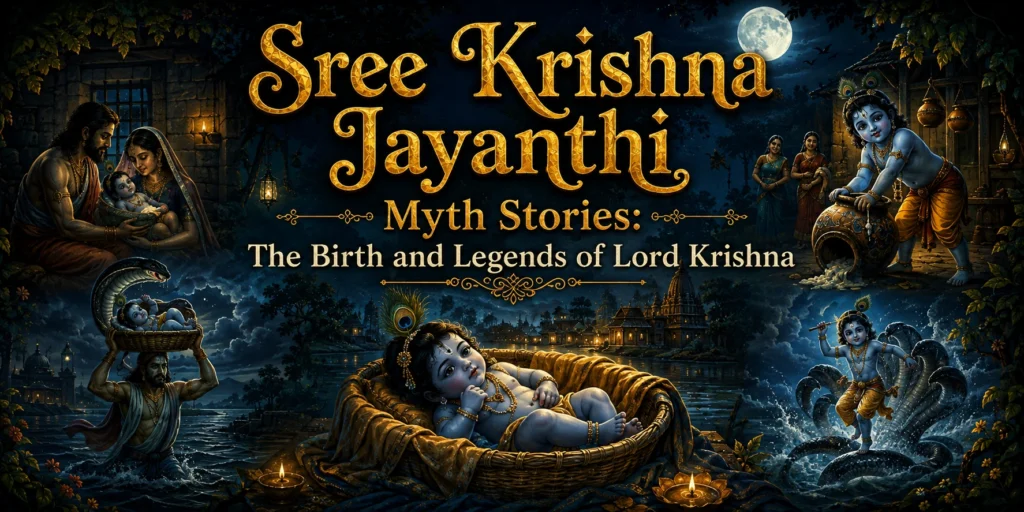
Sree Krishna Jayanthi, also known as Janmashtami, celebrates the birth of Lord Krishna, one of the most beloved figures in Hindu mythology. Across Kerala and other parts of India, devotees celebrate this day with prayers, songs, fasting, storytelling, and special rituals.
But behind the celebrations are powerful stories filled with miracles, devotion, courage, and divine purpose. The stories of Krishna begin with a prophecy about a dangerous king and continue through his mysterious birth, childhood adventures in Gokulam, and his role in the great battle of the Mahabharata.
These stories are not only religious tales. They have also become an important part of Indian folklore, art, music, theatre, and cultural traditions.
Let us explore some of the most famous Sree Krishna Jayanthi myth stories and understand why they continue to inspire people today.
The Prophecy That Changed Mathura
The story of Krishna begins in the ancient city of Mathura. King Kamsa ruled the kingdom and was known for his cruel and powerful nature.
Kamsa’s life changed during the wedding of his sister Devaki and Vasudeva. According to the traditional story, a divine voice announced a terrifying prophecy: Devaki’s eighth son would be the cause of Kamsa’s death.
Fear immediately took over Kamsa. He imprisoned Devaki and Vasudeva and watched every child born to them. According to the traditional account, Kamsa killed their first six children.
The seventh pregnancy was also surrounded by divine intervention. The unborn child was miraculously transferred to Rohini, another wife of Vasudeva. This child later became Balarama, Krishna’s elder brother.
Then came the eighth child.
The Divine Birth of Krishna
On a dark night, Devaki gave birth to Krishna inside the prison at Mathura. The traditional story describes the moment as a divine event.
Krishna appeared with extraordinary signs of his divine nature. He revealed to his parents that he had come to restore righteousness and destroy evil.
However, the newborn Krishna could not remain in the prison because Kamsa would try to kill him.
Vasudeva was instructed to take the baby across the Yamuna River to Gokulam. There, he would exchange Krishna with the newborn daughter of Yashoda and Nanda.
This journey became one of the most famous episodes associated with Krishna’s birth.
Vasudeva Crosses the Yamuna
Vasudeva carried baby Krishna in a basket and walked through the night.
According to the traditional mythology, the prison doors opened mysteriously and the guards fell into a deep sleep. Vasudeva then reached the Yamuna.
The river was flowing strongly, making the journey dangerous. Yet Vasudeva continued forward while protecting the baby.
One of the most popular images from Krishna mythology comes from this moment: the many-headed serpent Shesha protecting baby Krishna from the rain with its hood.
Vasudeva eventually crossed the river and reached the home of Nanda and Yashoda in Gokulam.
He placed Krishna beside Yashoda and returned to Mathura with the newborn girl.
When Kamsa discovered the child, he attempted to kill her. But the baby escaped his hands and revealed herself as a divine goddess, warning Kamsa that the person destined to destroy him was already alive.
This story explains why Krishna’s birth is celebrated as a victory of divine protection over evil.
Krishna’s Childhood in Gokulam
Krishna grew up in Gokulam under the loving care of Nanda and Yashoda.
His childhood stories are among the most popular Krishna legends.
Unlike the serious events surrounding his birth, these stories show Krishna as a playful child. He loved butter, played with his friends, and often created trouble for the people of Gokulam.
One famous story tells how Krishna and his friends would steal butter from houses. This earned him the affectionate name Makhan Chor, meaning the butter thief.
Yashoda often tried to discipline him, but Krishna’s innocence and charm made it difficult to remain angry with him.
These stories created the familiar cultural image of Balakrishna, the playful divine child.
The Story of Putana
Kamsa remained afraid of Krishna even after the child disappeared from Mathura.
He sent several demons to kill Krishna.
One of the most famous was Putana, who appeared in the form of a beautiful woman. She approached Krishna and attempted to poison him by feeding him from her breast.
But Krishna recognized the danger.
According to the traditional story, Krishna drank not only the poisoned milk but also her life force. Putana returned to her original monstrous form and died.
The story became an important example of Krishna’s divine power even during childhood.
Krishna and the Kaliya Serpent
Another famous Krishna story takes place in the Yamuna.
A poisonous serpent named Kaliya had made part of the river dangerous. The poison affected the water and created fear among the people and animals living nearby.
One day, Krishna entered the river and confronted Kaliya.
A dramatic battle followed. Krishna eventually climbed onto the serpent’s many heads and danced upon them.
Kaliya realized Krishna’s divine power and surrendered.
Krishna then allowed the serpent to leave the river with his family.
The story is often understood as a symbolic victory of divine order over destructive forces.
Krishna Lifts Govardhan Hill
The Govardhan Hill story is another major Krishna legend.
The people of Gokulam traditionally worshipped Indra, the god associated with rain and storms. Krishna questioned whether they should instead honor Govardhan Hill, the land, forests, animals, and natural resources that supported their lives.
The villagers followed Krishna’s advice.
Indra became angry and sent heavy rain over Gokulam.
To protect the villagers, Krishna lifted Govardhan Hill on his little finger and asked everyone to take shelter beneath it.
The rain continued for days, but the people remained safe.
Eventually, Indra understood Krishna’s divine nature and stopped the storm.
The story is often interpreted as a lesson about humility, nature, community, and devotion.
Krishna and the Flute
The image of Krishna playing the flute is deeply connected with Indian culture.
According to Krishna traditions, Krishna’s flute attracted the people of Vrindavan and especially the Gopis.
The sound of the flute became a symbol of divine attraction and spiritual love.
The stories of Krishna and the Gopis form an important part of Bhakti traditions. Their devotion represents the soul’s longing to unite with the divine.
The famous Ras Leela stories also developed from this tradition.
These stories have inspired countless forms of Indian classical music, dance, painting, poetry, and devotional literature.
The Story of Radha and Krishna
Radha and Krishna are among the most famous divine pairs in Indian devotional tradition.
Although the details and prominence of Radha vary across different texts and traditions, later devotional traditions made their relationship a powerful symbol of unconditional love and devotion.
Radha’s devotion to Krishna is often understood as representing the soul’s complete surrender to the divine.
Their story is therefore more than a romantic tale. In Bhakti traditions, it represents spiritual love that goes beyond ordinary worldly attachment.
Krishna’s Return to Mathura
As Krishna grew older, his life moved from the peaceful world of Gokulam toward his destiny in Mathura.
Kamsa eventually learned that Krishna was living among the cowherds.
He invited Krishna and Balarama to Mathura, hoping to defeat them.
Instead, Krishna confronted Kamsa.
After a fierce struggle, Krishna defeated and killed the tyrant king.
The prophecy had finally been fulfilled.
This moment represents one of the central themes of Krishna mythology: the triumph of dharma over adharma.
Krishna and the Mahabharata
Krishna’s story does not end with his childhood.
He later became one of the most important figures in the Mahabharata.
He became a close friend and guide to the Pandavas, especially Arjuna.
Before the Kurukshetra war, Arjuna became confused and unwilling to fight. Krishna then gave him spiritual guidance.
This conversation became the Bhagavad Gita, one of the most influential philosophical texts in Indian tradition.
Krishna taught Arjuna about duty, action, knowledge, devotion, and the nature of the self.
One of the central teachings associated with the Gita is that people should perform their rightful duties without becoming attached to the results.
Why Krishna Jayanthi Is Celebrated
Krishna Jayanthi celebrates the divine birth of Krishna.
Different regions follow different traditions for determining the exact date, but the celebration is generally associated with the Ashtami Tithi of the Krishna Paksha in the month of Shravana or Bhadrapada, depending on the calendar tradition.
Devotees may observe fasting, visit temples, sing devotional songs, listen to Krishna stories, and participate in special prayers.
In Kerala, Krishna Jayanthi celebrations can also have a strong cultural character. Children may dress as Krishna and Radha, temples organize devotional programs, and traditional performances help keep the stories alive.
Krishna Jayanthi and Kerala’s Cultural Traditions
In Kerala, Krishna Jayanthi is often connected with colorful celebrations organized by temples, cultural groups, and families.
Children dressed as little Krishnas can be seen participating in processions and cultural programs.
Decorations may include footprints symbolizing baby Krishna entering the home.
These tiny footprints are especially meaningful. They create the image of Krishna walking into the house and bringing divine blessings.
Such traditions show how mythology becomes part of everyday cultural life.
The story is no longer simply something read in a book. It becomes something families perform, celebrate, sing, and pass from one generation to another.
The Deeper Meaning Behind Krishna’s Stories
The myths surrounding Krishna contain several recurring themes.
Good versus evil: Krishna’s birth and his victory over Kamsa represent the restoration of righteousness.
Faith and devotion: The devotion of Yashoda, Radha, the Gopis, and Krishna’s followers demonstrates different forms of spiritual love.
Courage: Krishna repeatedly confronts powerful enemies instead of allowing fear to control him.
Humility: The Govardhan story teaches that even powerful figures must recognize their limitations.
Duty: Krishna’s teachings to Arjuna emphasize the importance of performing one’s responsibility.
These ideas help explain why Krishna’s stories remain meaningful even after centuries.
Why These Myth Stories Still Matter
Sree Krishna Jayanthi is more than a celebration of a historical or mythological birth.
It is a celebration of stories that have shaped Indian culture for generations.
From the mischievous Balakrishna stealing butter to the divine guide who speaks to Arjuna on the battlefield, Krishna appears in many forms.
He is a child, friend, protector, warrior, philosopher, and divine teacher.
That variety is one of the reasons Krishna remains such a powerful figure in Indian mythology.
Every generation discovers something different in his stories.
Conclusion
The myth stories of Sree Krishna Jayanthi take us through a fascinating journey filled with prophecy, miracles, childhood adventures, battles, devotion, and spiritual wisdom.
From the midnight birth in Mathura to the playful days of Gokulam and the teachings of the Bhagavad Gita, Krishna’s story connects mythology with culture and philosophy.
Sree Krishna Jayanthi reminds devotees of a timeless idea: when darkness grows stronger, hope and righteousness can still rise.
That is why Krishna’s birth continues to be celebrated with devotion, joy, music, storytelling, and colorful traditions across India.