
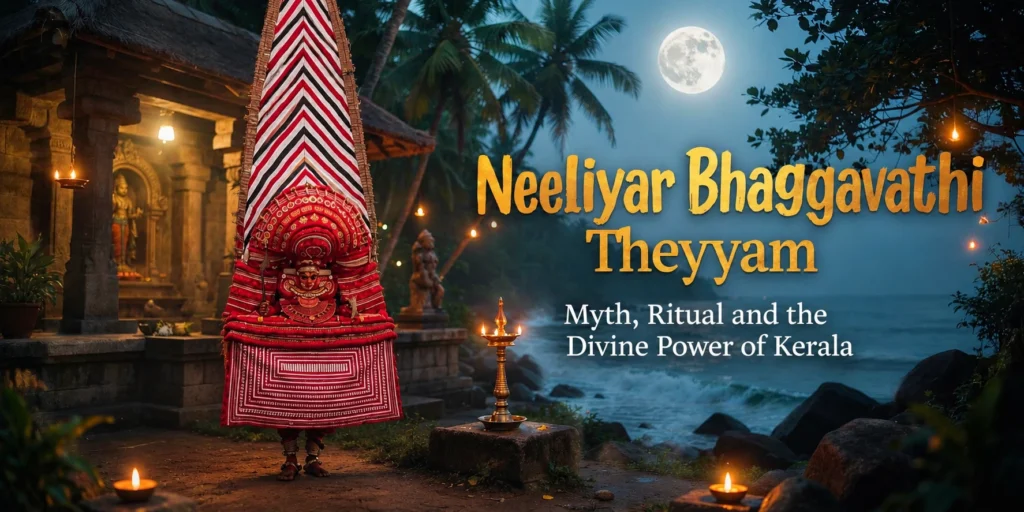
Kerala is home to many sacred traditions where mythology, ancestral memory, nature, and worship come together. Among the many forms of Theyyam performed in North Kerala, Neeliyar Bhagavathi Theyyam represents the powerful presence of a divine feminine spirit connected with local folklore and ritual worship.
The appearance of the Theyyam is not simply a colourful performance. For devotees, the performer becomes a temporary embodiment of the deity, creating a sacred space where people seek blessings, protection, guidance, and relief from difficulties.
But who is Neeliyar Bhagavathi? What is the story behind this goddess? Why is her Theyyam performed, and what do the elaborate costume, makeup, dance, music, and rituals represent?
Let us explore the mythology and cultural world surrounding Neeliyar Bhagavathi Theyyam.
What Is Neeliyar Bhagavathi Theyyam?
Neeliyar Bhagavathi Theyyam is a ritual manifestation of Bhagavathi, the divine mother or goddess worshipped in various forms across Kerala. The tradition belongs to the wider cultural landscape of Theyyam, particularly associated with the ritual traditions of northern Kerala.
Theyyam combines several elements at once: dance, music, mythology, body painting, elaborate costumes, sacred rituals, and community worship. Each Theyyam has its own identity, origin story, costume style, performance sequence, and ritual significance.
Neeliyar Bhagavathi is understood through the local traditions and oral histories preserved by communities. Because Theyyam traditions are often transmitted orally, details of mythology and ritual can vary between different sacred spaces and regions.
This makes the tradition especially important from a folklore and cultural heritage perspective.
The Mythology of Neeliyar Bhagavathi
The mythology surrounding Neeliyar Bhagavathi belongs to Kerala’s rich tradition of goddess worship and oral storytelling.
Like many Theyyam deities, the identity of Neeliyar Bhagavathi is not always explained through one universally fixed written legend. Instead, stories may survive through ritual songs, oral narratives, family traditions, temple customs, and local memory.
The goddess is associated with divine feminine power and is approached as a protective presence. Her worship reflects an important feature of Kerala folklore: supernatural beings are not always distant figures from ancient mythology. They can become deeply connected with a particular place, community, shrine, family, or ancestral tradition.
Through Theyyam, these stories remain alive.
Neeliyar Bhagavathi and Shakti Worship
The concept of Shakti, or divine feminine energy, occupies an important position in Indian religious traditions.
In Kerala, this idea appears through numerous forms of Bhagavathi worship. Different communities may worship different manifestations of the goddess, each connected with its own mythology and ritual practices.
Neeliyar Bhagavathi can therefore be understood within this broader cultural framework of mother-goddess worship, protection, fertility, prosperity, and spiritual power.
The goddess is not represented only as a symbol of beauty or motherhood. She can also embody strength, courage, justice, protection, and supernatural authority.
This powerful feminine presence is one of the reasons Bhagavathi traditions occupy such an important place in Kerala’s ritual culture.
The Theyyam Performance
When Neeliyar Bhagavathi Theyyam begins, the atmosphere of the sacred space changes dramatically.
Traditional instruments create a powerful rhythm while the performer prepares for the ritual. The distinctive makeup, costume, ornaments, headgear, movements, and facial expressions gradually transform the performer into the visual form associated with the deity.
The performance may involve ritual preparation, invocation, dance, movement around the sacred space, interaction with devotees, and blessings.
For devotees, the most important moment is not simply watching the performance. It is experiencing the presence of the deity through the ritual.
Costume and Appearance
One of the most recognizable characteristics of Theyyam is its extraordinary visual design.
The performer may wear elaborate ornaments and a carefully prepared costume that distinguishes the deity from ordinary human identity. Facial makeup and body decoration further contribute to the transformation.
The colours, patterns, ornaments, and headgear used in Theyyam are not merely decorative. They help communicate the identity, power, character, and sacred status of the deity.
Every visual element contributes to the overall ritual experience.
Music and Ritual Atmosphere
Music plays an essential role in Theyyam.
Traditional percussion instruments create rhythms that accompany the movements of the performer and intensify the atmosphere of the ritual. The sound of drums, chants, and ritual music helps establish a connection between the physical world and the sacred performance.
For many spectators, the combination of fire, drums, costume, dance, chanting, and movement creates an unforgettable experience.
The music is therefore not simply background sound. It forms an important part of the ritual structure.
Why Do Devotees Seek Neeliyar Bhagavathi?
The relationship between devotees and Theyyam deities is deeply personal.
People may approach a deity seeking blessings, protection, prosperity, justice, courage, or guidance. They may also participate in rituals connected with family traditions and local sacred spaces.
The Theyyam performer may listen to devotees, offer blessings, and participate in ritual interactions.
This creates a unique relationship between folklore and everyday life. Mythology is not simply something remembered from the past—it becomes part of the living community.
Neeliyar Bhagavathi in Kerala Folklore
Kerala folklore contains thousands of stories about goddesses, spirits, heroes, ancestors, magical beings, sacred groves, temples, and village deities.
Theyyam is one of the strongest living traditions through which these stories continue to survive.
Neeliyar Bhagavathi represents this connection between oral tradition and ritual practice.
Instead of reading a story in a book, the community experiences it through performance. The story becomes visible through costume, audible through ritual music, and meaningful through participation.
That is what makes Theyyam different from ordinary theatrical performance.
The Cultural Significance of Neeliyar Bhagavathi Theyyam
Neeliyar Bhagavathi Theyyam has significance beyond religious worship.
1. Preservation of Oral Tradition
Many Theyyam traditions are passed from generation to generation through oral transmission. Ritual knowledge, songs, performance techniques, and stories help preserve local cultural memory.
2. Community Identity
Theyyam creates a strong relationship between communities and their sacred spaces. Annual performances can become important cultural occasions that bring people together.
3. Living Folklore
Unlike folklore preserved only in books or museums, Theyyam continues to be practiced as a living tradition.
4. Divine Feminine Power
Bhagavathi traditions highlight the cultural importance of the goddess as a powerful divine presence associated with protection and spiritual authority.
5. Cultural Heritage
Theyyam contributes significantly to Kerala’s cultural identity and has become an important subject for researchers, photographers, artists, filmmakers, and cultural travellers.
Neeliyar Bhagavathi Theyyam and Sacred Spaces
Theyyam is closely connected with sacred landscapes.
Performances can take place in traditional kavus, tharavads, temples, and other ritual spaces, depending on the particular Theyyam tradition.
A sacred grove, for example, is not simply a collection of trees. Within Kerala’s traditional belief systems, such spaces can represent a relationship between nature, spirits, ancestors, and the divine.
This connection between landscape and mythology is an important part of understanding Theyyam.
A Living Connection Between Myth and Society
One of the most fascinating aspects of Neeliyar Bhagavathi Theyyam is the way it connects mythology with social life.
A story may begin as an oral tradition, become associated with a sacred place, and eventually become part of an annual ritual. Generations later, the community continues to participate in that ritual.
This creates a chain:
Myth → Oral Tradition → Sacred Space → Ritual → Community Memory → Future Generations
Through this process, folklore remains alive rather than becoming only a historical record.
Neeliyar Bhagavathi Theyyam as a Cultural Experience
For someone experiencing Theyyam for the first time, the visual impact can be overwhelming.
The intense drumming, dramatic makeup, elaborate costume, powerful movements, and ritual atmosphere create something very different from a conventional cultural show.
However, visitors should remember that Theyyam is primarily a sacred ritual, not simply a tourist performance.
Respecting local customs, photography rules, sacred spaces, performers, and devotees is essential when attending a Theyyam ritual.
Why Neeliyar Bhagavathi Theyyam Matters Today
Modern life is changing rapidly, but traditional practices such as Theyyam continue to preserve important aspects of Kerala’s cultural memory.
They provide a connection to local mythology, ancestral traditions, community identity, craftsmanship, music, dance, and ritual knowledge.
At the same time, Theyyam faces challenges such as commercialization, changing lifestyles, and the difficulty of preserving traditional knowledge.
Documenting and understanding traditions such as Neeliyar Bhagavathi Theyyam can help future generations appreciate the cultural history behind the ritual.
Conclusion
Neeliyar Bhagavathi Theyyam is more than a spectacular ritual performance. It represents a living relationship between goddess worship, mythology, oral tradition, community memory, and sacred space.
Through the performer, the deity becomes present in a form that the community can see, hear, and interact with. Through music and dance, old stories continue to travel from one generation to another. Through ritual, folklore remains connected to everyday life.
The true beauty of Neeliyar Bhagavathi Theyyam lies not only in its striking appearance but in the stories, beliefs, memories, and cultural identity carried behind the performance.
For anyone interested in Kerala folklore, Theyyam, mythology, or traditional ritual culture, Neeliyar Bhagavathi offers another fascinating window into the living heritage of Kerala.