
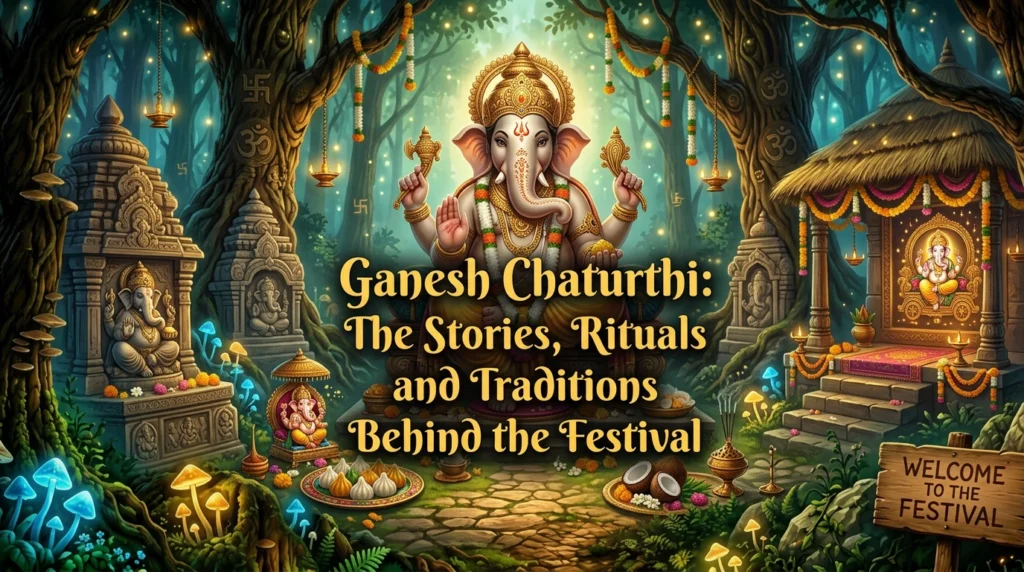
Every year, the arrival of Ganesh Chaturthi transforms homes, temples, and public spaces into colorful celebrations filled with devotion, music, flowers, and beautifully decorated idols of Lord Ganesha. For millions of devotees, the festival is more than a religious celebration. It is a time to seek blessings, remove obstacles, welcome prosperity, and bring communities together.
But behind the flowers, modaks, decorations, and processions lies a fascinating collection of Hindu mythology, folklore, rituals, and traditions. The stories surrounding Lord Ganesha have been passed from generation to generation, creating a cultural tradition that continues to evolve.
So, what is the story behind Ganesh Chaturthi? Why is Lord Ganesha worshipped first? What happens during the festival, and why does the celebration end with Ganesh Visarjan?
Let’s explore the mythology, rituals, symbolism, and traditions that make Ganesh Chaturthi one of India’s most recognizable festivals.
What Is Ganesh Chaturthi?
Ganesh Chaturthi, also known as Vinayaka Chaturthi, is a Hindu festival dedicated to Lord Ganesha, the elephant-headed deity associated with wisdom, knowledge, prosperity, and the removal of obstacles.
The festival traditionally begins on the fourth day (Chaturthi) of the Shukla Paksha in the Hindu month of Bhadrapada. Celebrations can continue for several days, with the final day marked by Ganesh Visarjan.
Although Ganesh Chaturthi is celebrated in many parts of India, large public celebrations are particularly associated with Maharashtra. The festival is also observed in Karnataka, Goa, Telangana, Andhra Pradesh, Tamil Nadu, Kerala, and other regions.
The form of the celebration varies from place to place. Some families celebrate privately at home, while communities organize large public pandals, cultural programs, music, processions, and immersion ceremonies.
The Mythological Story of Lord Ganesha’s Birth
One of the most famous stories connected with Ganesh Chaturthi describes how Lord Ganesha received his elephant head.
According to a widely told version of the mythology, Goddess Parvati created Ganesha from the material associated with her body and gave him the responsibility of guarding the entrance while she was bathing.
Parvati instructed Ganesha not to allow anyone to enter.
When Lord Shiva returned, Ganesha stopped him because he did not recognize Shiva as his father. A confrontation followed, and Shiva became angry. In the conflict, Ganesha was beheaded.
Parvati was devastated and furious when she discovered what had happened. She demanded that Ganesha be brought back to life.
Shiva agreed and instructed his followers to bring the head of the first suitable living being they encountered. They returned with the head of an elephant.
Shiva placed the elephant head on Ganesha’s body and restored him to life.
From this story came the familiar image of Ganesha as the elephant-headed god, combining human and animal symbolism in a powerful mythological form.
Why Does Ganesha Have an Elephant Head?
The elephant head is one of the most recognizable symbols in Hindu mythology.
Elephants are traditionally associated with qualities such as strength, intelligence, memory, patience, and wisdom. Ganesha’s large ears are often interpreted symbolically as representing the ability to listen carefully.
His trunk is flexible and powerful, representing adaptability and strength.
His large belly is often understood symbolically as the ability to accept and digest both the positive and difficult experiences of life.
These interpretations can vary across traditions, but together they make Ganesha a powerful cultural symbol of wisdom, learning, adaptability, and overcoming obstacles.
Why Is Ganesha Called the Remover of Obstacles?
One of Lord Ganesha’s most famous names is Vighnaharta, commonly understood as the remover of obstacles.
Devotees traditionally worship Ganesha before beginning important activities, ceremonies, journeys, businesses, educational pursuits, and other significant events.
This tradition is connected with the belief that seeking Ganesha’s blessings helps clear difficulties and create a favorable beginning.
This is also why Ganesha is often called Prathameshwar or associated with being worshipped first.
The idea is simple: before beginning something important, people seek wisdom and blessings to help them move forward.
The Story of Ganesha and His Parents
Another famous story explains Ganesha’s wisdom through a competition between him and his brother Kartikeya.
According to the popular story, Shiva and Parvati challenged their sons to travel around the world and return first.
Kartikeya immediately set off on his vehicle, the peacock.
Ganesha, however, remained where he was.
Instead of traveling around the physical world, he walked around his parents three times and explained that his parents represented his entire world.
His wisdom won the challenge.
The story is often told as an example of how intelligence, understanding, and perspective can be more important than physical speed or strength.
The Importance of Modak During Ganesh Chaturthi
No Ganesh Chaturthi celebration feels complete without modak.
Modak is a traditional sweet strongly associated with Lord Ganesha. It is commonly prepared using ingredients such as rice flour, coconut, jaggery, and cardamom, although recipes differ across regions.
The sweet is traditionally offered to Ganesha as naivedya, or food offered to the deity.
Modak is sometimes described as symbolizing spiritual knowledge or the sweetness of life.
Different regions have their own versions, including steamed modaks and fried varieties.
For many families, preparing modak is not simply cooking. It is part of the festival experience itself.
Ganesh Chaturthi Rituals and Traditions
Ganesh Chaturthi includes several important rituals. Their exact form can vary depending on regional and family traditions.
1. Bringing Home the Ganesha Idol
Many families begin the celebration by bringing a Ganesha idol into their home.
The idol may be placed on a decorated platform or altar known as a mandap.
Flowers, leaves, lamps, fabrics, and traditional decorations are often used to create the festive setting.
2. Prana Pratishtha
One of the important rituals associated with Ganesha worship is Prana Pratishtha.
The ritual is traditionally understood as invoking or ceremonially establishing the divine presence in the idol.
It is followed by various forms of worship and offerings.
3. Puja and Offerings
Devotees perform prayers and offer flowers, fruits, sweets, lamps, and other traditional offerings.
Durva grass is particularly associated with Ganesha worship.
Modak and other sweets are also offered as naivedya.
4. Aarti
Aarti is one of the most recognizable parts of the celebration.
Devotees gather around the idol while lamps are moved in a circular motion and devotional songs are sung.
In community celebrations, aarti can become a shared moment involving large groups of people.
5. Cultural Celebrations
Public Ganesh Chaturthi celebrations often extend beyond religious rituals.
Communities may organize:
- Music and devotional performances
- Cultural programs
- Traditional dances
- Food distribution
- Competitions
- Community gatherings
- Processions
This combination of devotion and community activity has helped Ganesh Chaturthi become a major cultural celebration.
Why Is Ganesh Visarjan Performed?
One of the most emotional moments of Ganesh Chaturthi is Ganesh Visarjan, the immersion of the Ganesha idol in water.
After several days of worship, devotees carry the idol in a procession to a river, lake, sea, or designated immersion location.
The immersion symbolizes the conclusion of the festival and the return of the deity to his divine realm.
It also represents an important philosophical idea: creation is temporary, and all physical forms eventually return to nature.
Devotees may chant traditional phrases and prayers while carrying the idol toward the immersion site.
The atmosphere can be both joyful and emotional because the community is celebrating while also saying goodbye to the festival’s physical representation of Ganesha.
The Environmental Side of Ganesh Chaturthi
Modern Ganesh Chaturthi celebrations have also created conversations about environmental responsibility.
Traditionally, idols made from natural clay can dissolve more easily in water. However, the widespread use of certain non-traditional materials and chemical-based paints has raised concerns about their impact on water bodies.
As a result, many communities and families now choose eco-friendly Ganesha idols, especially those made from natural clay and safer materials.
Some celebrations also use artificial immersion tanks to reduce pressure on natural water bodies.
These practices show how cultural traditions can adapt while maintaining their symbolic meaning.
Ganesh Chaturthi as a Community Festival
Ganesh Chaturthi is not only a household celebration.
In many places, it becomes a community event where people from different backgrounds participate in decorations, cultural programs, prayers, and public processions.
Large Ganesh pandals can become temporary cultural spaces where neighbors and visitors gather.
The festival therefore combines mythology, devotion, art, music, food, craftsmanship, and community participation.
This community dimension is one reason Ganesh Chaturthi has developed beyond a private religious observance into a major public cultural tradition.
The Historical Growth of Public Ganesh Chaturthi
The modern public form of Ganesh Chaturthi is strongly associated with Maharashtra.
During the late 19th century, Bal Gangadhar Tilak encouraged the organization of public Ganesh festivals. Public celebrations helped bring people together through religious and cultural activities.
Over time, these celebrations developed into large community events featuring elaborate idols, decorations, performances, and processions.
Today, Ganesh Chaturthi can look very different from one region to another, reflecting local customs and contemporary culture.
Ganesh Chaturthi Across India
Although Maharashtra is particularly famous for its large-scale celebrations, Ganesh worship is found throughout India.
In Karnataka, the festival is widely celebrated in homes and communities.
In Goa, Ganesh Chaturthi is an important family and cultural festival, with traditional celebrations often reflecting local customs.
In Tamil Nadu, the festival is commonly known as Vinayaka Chaturthi.
In Kerala, Ganesha worship can also be observed in temples and homes, although the style and scale of celebration may differ from the major public celebrations seen elsewhere.
This regional diversity shows how the same deity can become part of different local cultural traditions.
What Does Ganesh Chaturthi Symbolize?
Beyond mythology and ritual, Ganesh Chaturthi carries several symbolic ideas.
Wisdom: Ganesha is associated with knowledge and intelligent decision-making.
New Beginnings: Many people seek Ganesha’s blessings before starting something important.
Removing Obstacles: Ganesha is traditionally invoked to overcome difficulties.
Family and Community: The festival brings people together through shared rituals and celebrations.
Impermanence: Ganesh Visarjan reminds devotees that physical forms are temporary.
Respect for Nature: Eco-friendly celebrations connect traditional symbolism with modern environmental awareness.
Ganesh Chaturthi: More Than a Festival
Ganesh Chaturthi brings together many elements of Indian culture: mythology, religion, folklore, art, food, music, craftsmanship, family traditions, and community life.
The story of Ganesha’s birth explains the origin of his elephant head. His stories with Shiva, Parvati, and Kartikeya highlight wisdom and devotion. Modak represents the sweetness associated with the beloved deity, while rituals such as puja, aarti, and Visarjan give structure and meaning to the celebration.
Perhaps the most powerful part of the festival is its final moment.
The idol that people carefully create, decorate, worship, and celebrate is eventually immersed in water. The farewell reminds us that traditions can celebrate both arrival and departure, creation and dissolution, joy and change.
That is what makes Ganesh Chaturthi more than a festival on the calendar. It is a living cultural tradition that continues to connect mythology with everyday life.
Conclusion
Ganesh Chaturthi is a celebration of stories, faith, wisdom, tradition, and community. From the fascinating story of Ganesha’s birth to the preparation of modak, from colorful pandals to devotional aarti, every part of the festival carries cultural meaning.
And when the final Visarjan takes place, the festival leaves behind a simple message: beginnings and endings are both part of life.
Lord Ganesha may return symbolically to the divine, but his stories, traditions, and cultural memory continue to live on through generations.
Ganpati Bappa Morya!
Pray for wisdom. Celebrate tradition. Welcome new beginnings.