
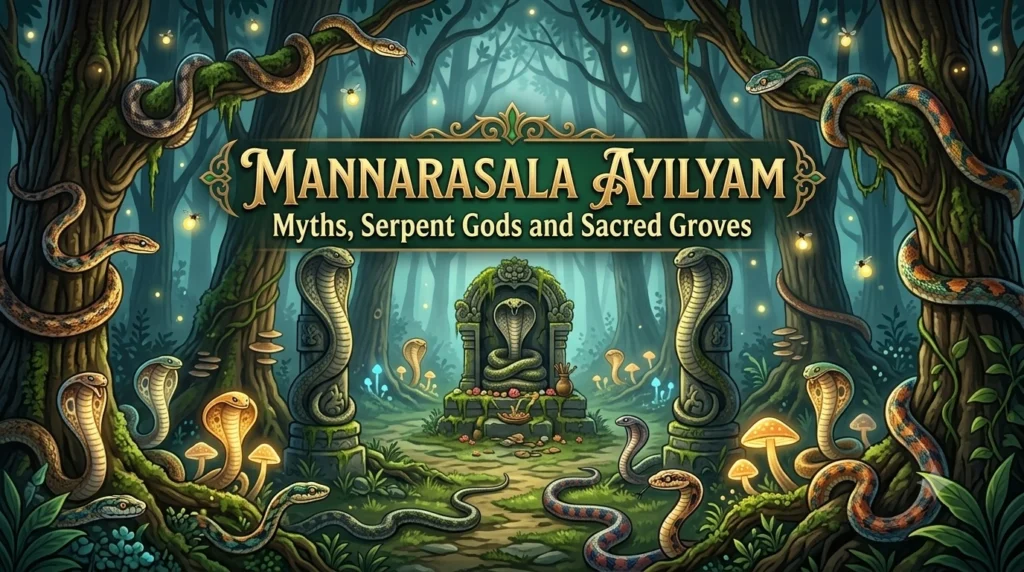
Deep inside the lush greenery of Kerala lies a sacred place where ancient serpent legends, religious devotion and the mysteries of nature come together. Mannarasala Sree Nagaraja Temple, near Haripad in Alappuzha district, is one of Kerala’s most recognised centres of serpent worship.
Every year, devotees gather here for Mannarasala Ayilyam, a festival dedicated to Nagaraja, the serpent deity. The celebration brings together traditional rituals, sacred serpent images and stories passed down through generations.
But Mannarasala is more than a place of worship. Its identity is closely connected with Kerala’s Sarpakavu tradition, in which sacred groves are dedicated to serpent deities. These green spaces reflect a cultural relationship between spirituality, family traditions and the natural world.
From the legendary origins of the temple to the significance of serpent gods and the rituals of Ayilyam, Mannarasala offers a fascinating glimpse into Kerala’s living folklore.
What Is Mannarasala Ayilyam?
Mannarasala Ayilyam is an annual religious festival celebrated at Mannarasala Sree Nagaraja Temple. It is associated with the Malayalam month of Thulam, when the Ayilyam star becomes the focus of special worship.
The festival honours Nagaraja and the serpent deities worshipped at the temple. Devotees visit to offer prayers, participate in rituals and seek blessings according to their family and religious traditions.
The celebration is particularly notable for its connection with serpent worship, which has a long history in Kerala’s religious and cultural landscape.
Why is Ayilyam significant?
- Serpent worship: The festival honours Nagaraja and the divine serpent tradition.
- Family and fertility beliefs: Some devotees associate serpent worship with fertility, family well-being and the removal of obstacles.
- Living folklore: Rituals and legends preserve stories that continue to hold meaning for worshippers.
- Sacred nature: The temple’s grove reflects the traditional connection between serpent deities and protected natural spaces.
These beliefs belong to a living religious tradition. Their meaning can vary among families and devotees.
The Legend of Mannarasala: Myths Behind the Sacred Temple
One of the most famous stories associated with Mannarasala connects the temple’s origins with the legendary figure of Parashurama.
According to a traditional account, Parashurama reclaimed the land of Kerala from the sea. However, the newly created land was affected by salinity, making it difficult for people to settle and cultivate it. Seeking a solution, Parashurama turned to Nagaraja, the divine serpent king.
In the legend, Nagaraja’s presence and blessings helped make the land suitable for habitation. The story explains why serpent worship became closely associated with Kerala and why Mannarasala holds a special place in this tradition.
The birth of the temple tradition
Another important legend tells of a Brahmin couple who prayed for a child. Their devotion was answered through the birth of a divine serpent child, who became associated with the sacred identity of Mannarasala.
The child is traditionally connected with Nagaraja and the temple’s spiritual lineage. The story also explains the special position of the women who serve as priestesses in the temple tradition.
These narratives are religious legends rather than independently established historical accounts. Their importance lies in how they express devotion, explain sacred customs and connect the temple with Kerala’s wider serpent folklore.
Nagaraja and the Serpent Gods of Mannarasala
Serpent worship is an important feature of Kerala’s religious heritage. At Mannarasala, the serpent deities are central to the temple’s identity, rituals and traditional stories.
Nagaraja: The Serpent King
Nagaraja is revered as the serpent king and the principal deity of Mannarasala. In Hindu religious traditions, serpent beings, often called Nagas, are associated with protection, fertility, water, prosperity and the hidden powers of the natural world.
At Mannarasala, devotees approach Nagaraja with prayers and offerings, seeking blessings according to their beliefs and family customs.
Nagayakshi: The Serpent Goddess
Nagayakshi is another important figure in serpent worship. She is understood within the temple’s religious tradition as a powerful feminine serpent deity.
The worship of Nagayakshi highlights the presence of divine feminine figures in Kerala’s sacred traditions. Serpent goddesses are often connected in folklore with protection, fertility and the safeguarding of families.
The wider world of Nagas
Nagas appear in numerous Hindu myths, regional legends and traditional narratives across South Asia. They may be depicted as divine serpents, guardians of treasures, protectors of water sources or beings who inhabit hidden realms.
At Mannarasala, these wider mythological themes become part of a local tradition shaped by the temple’s own legends, rituals and community practices.
Sacred Groves: The Mysterious World of Sarpakavu
One of the most distinctive features of Kerala’s traditional serpent worship is the Sarpakavu, or sacred serpent grove.
A Sarpakavu is a protected patch of vegetation associated with serpent deities. Such groves may contain trees, plants, small shrines and stone images representing Nagas. They are often maintained as sacred spaces where worship and customary restrictions guide how people interact with the land.
Mannarasala is closely associated with this tradition. Its grove and numerous serpent images create a landscape in which the natural environment and religious practice are deeply connected.
Why are sacred groves important?
1. Spiritual protection
In traditional belief, the grove is a dwelling place or sacred domain of serpent deities. People may avoid disturbing it because of religious respect and customary rules.
2. Cultural memory
Stories about the grove, its deities and its rituals are passed down through families and communities. The landscape itself becomes part of the tradition.
3. Nature and biodiversity
Sacred groves can preserve vegetation and provide habitat for local wildlife. Their ecological value depends on factors such as their size, condition and how they are managed.
4. Community responsibility
The protection of a grove may involve families, temple authorities and local communities. Religious customs can therefore influence how a natural space is cared for.
Sacred groves should not all be assumed to have identical rules or ecological conditions. Their practices and histories vary from place to place.
Mannarasala Ayilyam Rituals and Traditional Offerings
Rituals are an essential part of Mannarasala Ayilyam. They express devotion to Nagaraja and the serpent deities while preserving customs associated with the temple.
The exact sequence of observances can depend on the temple calendar and its established traditions. The following are important elements associated with serpent worship at Mannarasala.
Serpent images and offerings
The temple grounds are known for their many serpent images. Devotees offer prayers and traditional offerings as acts of reverence. Serpent images may also be connected with family vows and devotional practices.
Noorum Paalum
Noorum Paalum is a traditional offering associated with serpent worship in Kerala. It is commonly described as a mixture involving rice flour and turmeric, together with milk, offered according to customary ritual practice.
The offering reflects the distinctive ritual vocabulary of Kerala’s Sarpakavu tradition. Its preparation and use should be understood within the temple’s own religious customs.
Processions and collective worship
Ayilyam is associated with special observances and gatherings of devotees. The festival provides an opportunity for families and worshippers to participate in a shared expression of faith.
These practices are not merely ceremonial for devotees. They can also serve as a way of maintaining family traditions and passing religious knowledge to younger generations.
The Unique Role of the Priestess at Mannarasala
One of the distinctive aspects of Mannarasala is its tradition of a woman serving as the principal priestly figure, known as Mannarasala Amma.
This role is closely connected with the temple’s origin legends and hereditary religious customs. The priestess is associated with the performance and supervision of important rituals and with maintaining the temple’s spiritual traditions.
The position makes Mannarasala particularly notable within discussions of Kerala’s temple culture, where ritual responsibilities differ from one institution to another.
The story of the priestess also connects with the temple’s wider themes of motherhood, family continuity and devotion. These ideas appear in the traditional narratives surrounding the divine serpent child and the origins of the temple.
Serpent Worship and Fertility Beliefs
Serpent worship in Kerala is often connected with beliefs about fertility, childbirth, family well-being and protection. Mannarasala is especially associated with devotees who seek blessings relating to family life.
In traditional accounts, serpent deities may be approached through prayers and offerings when families face difficulties or wish to express gratitude. Some devotees also associate serpent worship with the hope of having children.
These are matters of religious faith and cultural practice, not scientifically established effects of ritual. Their significance can be understood through the emotional, spiritual and communal roles that worship plays in people’s lives.
Why do these beliefs continue?
- Family tradition: Religious practices are often inherited and maintained across generations.
- Hope and devotion: Rituals provide a meaningful way for devotees to express hopes, gratitude and concerns.
- Cultural identity: Serpent worship forms part of the religious heritage of many Kerala families.
- Community participation: Festivals and temple visits bring people together through shared customs.
The continuing practice of serpent worship demonstrates how folklore can remain active within contemporary religious life rather than existing only in old stories.
Mannarasala in Kerala’s Folklore and Cultural Heritage
Mannarasala is an example of how folklore, religious practice and landscape can become closely connected.
Its legends explain the sacred importance of the place. Its serpent deities provide a focus for worship. Its grove reflects a traditional understanding of nature as a space that may carry spiritual meaning.
The temple also illustrates how folklore can be preserved through more than storytelling. Rituals, offerings, hereditary responsibilities, sacred images and annual festivals all help transmit cultural knowledge.
For researchers and cultural enthusiasts, Mannarasala offers several ways to explore Kerala’s heritage:
- Mythology: The stories of Parashurama, Nagaraja and the temple’s origins.
- Religious traditions: Serpent worship, ritual offerings and the role of the priestess.
- Environmental culture: The Sarpakavu and the customary protection of sacred spaces.
- Living heritage: The continuation of festivals and devotional practices in the present day.
These dimensions make Mannarasala relevant to the study of folklore, anthropology, religious studies and Kerala’s cultural history.
How to Reach Mannarasala Temple
Mannarasala Sree Nagaraja Temple is situated near Haripad in Alappuzha district, Kerala.
Location: Mannarasala Sree Nagaraja Temple, Haripad, Alappuzha district, Kerala, India.
By train: Haripad Railway Station is a nearby rail access point. Visitors can arrange local transport from the station to the temple.
By road: Haripad is connected to other parts of Alappuzha district and Kerala by road. Local buses and taxis may be available, depending on the route and time.
Before visiting: Check the temple’s current opening hours, festival schedule, offerings and visitor guidelines through an official temple source before travelling, especially during Ayilyam.
Why Mannarasala Ayilyam Still Matters Today
Mannarasala Ayilyam continues to hold meaning for devotees because it brings together faith, family customs, mythology and a sense of connection with the natural world.
For some visitors, the temple is primarily a place of prayer. For others, it is an opportunity to learn about Kerala’s serpent legends and the traditions surrounding sacred groves.
Its cultural significance also lies in the way its stories are kept alive. The legends are remembered through ritual, the sacred landscape is treated with reverence, and the annual festival brings people together around a shared heritage.
At a time when many traditional practices are changing, Mannarasala offers an example of how a religious institution can continue to preserve local stories and customs while remaining part of contemporary community life.
Conclusion
Mannarasala Ayilyam is much more than an annual festival. It is a living expression of Kerala’s rich tradition of serpent worship, where mythology, devotion and sacred nature meet.
The legends of Parashurama and Nagaraja explain the temple’s sacred identity, while the worship of serpent deities reflects longstanding beliefs about protection, fertility and family well-being. The Sarpakavu adds another important dimension, connecting religious customs with the care and cultural meaning of the natural environment.
Through its rituals, priestly traditions and annual celebrations, Mannarasala continues to preserve stories that have been passed down through generations.
For anyone interested in Kerala folklore, Mannarasala Ayilyam offers a fascinating opportunity to explore how myths become traditions and how those traditions remain alive in the present.